



Get Started

Amazon Fair Pricing & Sales Velocity Suspensions Explained (2026)

Posted by
Samuel Kanar
Posted date
June 5, 2026
Two of the most confusing suspensions Amazon hands out look like punishments for doing well. One hits you for the price on your listing. The other hits you for selling too fast. Both are triggered almost entirely by algorithms, both can freeze your funds, and both leave sellers staring at a notification that feels completely backward: I raised a price to protect my margin, and I'm suspended. My product went viral, and I'm suspended.
These are Amazon's Fair Pricing and Sales Velocity enforcement actions, and they share a root cause. Amazon's systems are built to spot anything that deviates from a 'normal,' trusted pattern, then act first and ask questions later. A repricer nudging a price during a stockout looks identical to price gouging. A TikTok-driven sales spike looks identical to fraud or a hijacked account. The system can't tell the difference until you prove it.
At Appeals Doctor, we've helped thousands of sellers resolve pricing and velocity enforcement and recover held funds. This guide explains exactly what triggers each suspension, what Amazon wants to see in your response, and how to protect your account in 2026.
What Is the Amazon Marketplace Fair Pricing Policy?
The Amazon Marketplace Fair Pricing Policy gives Amazon the right to take action against any pricing practice it judges to harm customer trust. It isn't a fixed price ceiling. It's a discretionary standard, and Amazon enforces it across your whole account, not just the offending offer.
When Amazon decides a price is unfair, it can respond in escalating ways:
- Remove the offer from featuring (loss of the Buy Box)
- Remove the offer entirely
- Suspend the ASIN
- Suspend or permanently terminate your selling privileges for serious or repeated violations
The critical thing to understand for 2026: this is almost never a human reading your listing. With billions of price changes flowing through the marketplace every day, enforcement is overwhelmingly algorithmic, automated, and increasingly tied to your broader account health profile. A single flagged price can put your entire account under a cloud.
What Triggers a Fair Pricing Suspension
Amazon's systems compare your price against reference points and flag outliers. The most common triggers we see:
- A price significantly higher than recent history. Your price is well above what the item recently sold for on Amazon, or above what it's listed for at other major retailers or the brand's own website.
- Excessive shipping fees. Shipping charges that exceed reasonable, standard carrier rates for the item.
- Per-unit multipack pricing errors. A multipack that costs more per unit than buying the single - a classic, easily-flagged mistake.
- Repricer surges. An automated repricing tool drives your price up during a low-competition window or a stockout, with no ceiling to catch it.
- Disruption and disaster pricing. Failing to hold or lower prices during shortages, weather events, or demand spikes is treated as price gouging, even when your repricer did it automatically.
The recurring theme is that you don't have to intend to gouge. If your price looks like gouging to an algorithm, you carry the burden of proving it wasn't.
What Is an Amazon Sales Velocity Review?
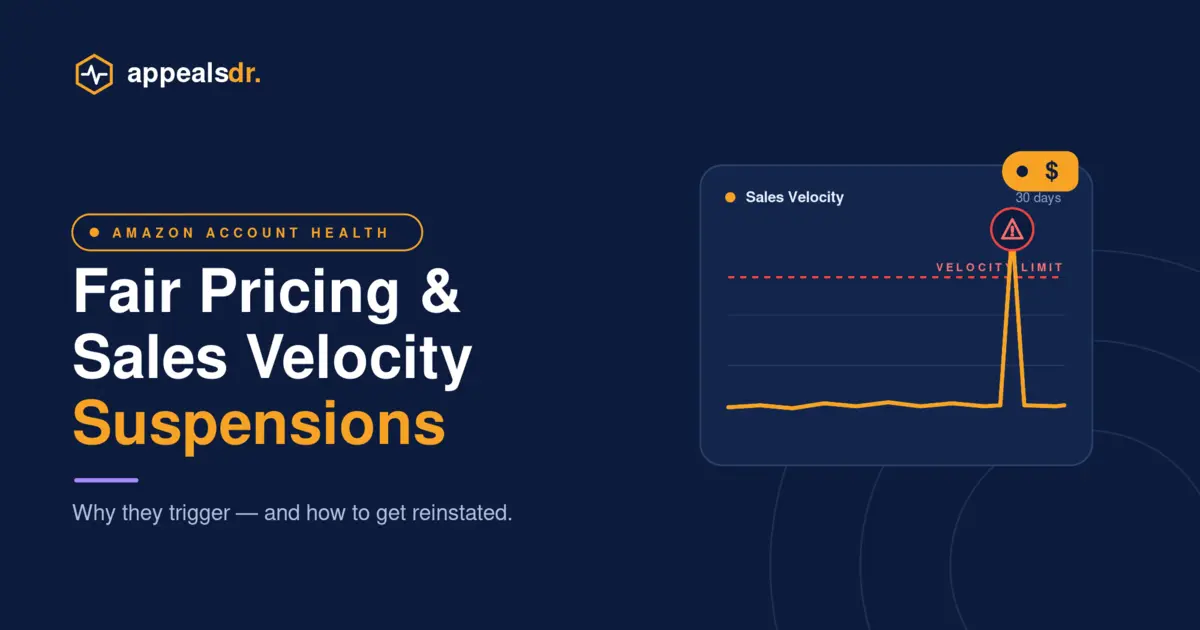
Sales velocity is simply how fast your products sell over a given period. Normally, rising velocity is the goal. But Amazon assigns accounts an internal velocity limit, and any sudden, unusual spike above your established pattern gets that limit reassessed - often by pausing your account first.
Amazon monitors selling patterns closely and treats unexpected spikes as red flags for three reasons:
- Fraud risk. A compromised or fraudulently opened account often shows a sudden burst of orders.
- Fulfillment risk. Amazon worries you can't actually fulfill a 10x order surge, which would flood the marketplace with late shipments, cancellations, and angry customers.
- Customer-service risk. A spike in volume you're not staffed for becomes a spike in defects, returns, and A-to-z claims.
So the platform pumps the brakes. If your sales jump too quickly, Amazon may suspend the account, apply a temporary selling restriction, or - most painfully - hold your disbursements for verification while it investigates.
What Amazon Requests During a Velocity Review
A velocity review is fundamentally a 'prove you're a real, legitimate business that can handle this volume' exercise. To move it along, Amazon typically wants:
- Your business and trading history
- Your Tax ID or D-U-N-S number
- Any retail locations and websites you operate
- Who your suppliers are (with supporting documentation)
- A monthly sales estimate
- How you track inventory and how quickly you ship
Once an account is watchlisted, the velocity limit is generally reassessed within 30 to 90 days. Funds held during that window are released once Amazon is satisfied - which makes the speed and completeness of your response directly tied to your cash flow.
How Fair Pricing and Velocity Suspensions Overlap
These two enforcement types frequently arrive together, and that's no coincidence. A product that suddenly takes off creates exactly the conditions that trip both systems at once:
- Demand surges, so your repricer pushes the price up → fair pricing flag
- Orders spike far above your baseline → velocity review
- You scramble to restock and cancel oversold orders → performance metric damage (cancel rate, late shipments)
One viral moment can therefore generate a pricing flag, a velocity hold, and an Order Defect Rate spike simultaneously. Treating these as one connected event - rather than three separate fires - is the difference between a clean recovery and a cascading account crisis.
How to Appeal a Fair Pricing Suspension
Your Plan of Action (POA) must follow the same three-part structure Amazon expects for any appeal: root cause, corrective actions, and prevention. The nuance with fair pricing is that you must acknowledge the pricing control failure without arguing that the price itself was justified.
1. Root Cause Analysis. State the specific mechanism that allowed the flagged price. Don't argue Amazon was wrong.
Example: 'The fair pricing concern was triggered because our automated repricing tool had no maximum price ceiling configured. When competing offers went out of stock on March 3, 2026, our repricer raised ASIN B0XXXXXXX from $24.99 to $79.99 within hours, far above its recent selling price.'
2. Immediate Corrective Actions. Past tense, dated, concrete.
- 'On March 4, 2026, we lowered the affected ASIN back to $24.99.'
- 'On March 4, we set a maximum price ceiling of $29.99 on all repricer rules.'
- 'On March 5, we audited all 312 active listings and corrected 4 additional ASINs with multipack per-unit pricing errors.'
3. Long-Term Prevention. Durable controls with an owner and review cadence.
Example: 'We implemented a pricing-governance process owned by our Operations Manager: every repricer rule now requires a minimum and maximum price boundary tied to MSRP; a weekly pricing audit cross-checks our prices against Amazon and off-Amazon retail; and any price change above 15% triggers a manual review before it goes live.'
How to Respond to a Sales Velocity Review
A velocity review is less about a POA and more about fast, credible verification. The instinct to fire off an emotional 'why are you punishing my success?' message is the single most damaging thing you can do.
Instead:
- Respond fast and completely. Submit the full documentation set (trading history, Tax ID/D-U-N-S, supplier details, sales estimates, shipping process) in one organized package rather than in trickled-out pieces.
- Prove fulfillment capacity. Show that your inventory levels and shipping operation can actually support the new volume - this is the core of Amazon's concern.
- Explain the spike credibly. If a promotion, press feature, influencer, or seasonal event drove the jump, document it. A verifiable cause defuses the fraud assumption.
- Don't fight the hold. Funds are released after verification. Speed of compliance, not argument, gets your money back.
Example framing: 'Our order volume increased from an average of 40 to 600 units per day beginning March 1, 2026, following a feature on [verifiable source]. Attached is our supplier purchase order dated February 20 for 10,000 units, our inventory report confirming stock on hand, and our fulfillment SOP demonstrating same-day shipping capacity at this volume.'
How to Prevent Pricing and Velocity Suspensions
The best appeal is the one you never write. Build these controls before a flag ever fires:
- Cap your repricer. Every automated rule needs a hard maximum price. This single setting prevents the majority of fair pricing suspensions.
- Benchmark off-Amazon. Periodically check your prices against the brand site and major retailers, not just Amazon competitors.
- Fix multipack math. Confirm every multipack's per-unit price is lower than the single-unit offer.
- Scale capacity ahead of demand. Before a launch, promotion, or seasonal push, pre-position inventory and customer-service staffing so a spike doesn't break your metrics.
- Keep verification documents ready. Maintain a current folder with your Tax ID/D-U-N-S, supplier invoices, and a written fulfillment SOP so you can answer a velocity review in hours, not weeks.
- Watch your Account Health dashboard. Pricing and velocity flags often appear alongside Buy Box loss and metric warnings - early signs you can act on.
When to Get Professional Help
Some pricing and velocity situations are too high-stakes to handle alone:
- Your disbursements are frozen and cash flow is at risk
- Your appeal or verification has already been rejected once
- A single viral event triggered pricing, velocity, and performance issues simultaneously
- You can't quickly produce the supplier or business documentation Amazon is demanding
- Your business depends entirely on Amazon revenue and can't absorb an extended hold
- You're facing repeated fair pricing flags and need a systemic pricing-governance overhaul
Appeals Doctor specializes in pricing and velocity enforcement with proven strategies for releasing held funds and restoring selling privileges fast.
Get Your Amazon Account Back With Expert Help
A fair pricing or sales velocity suspension doesn't mean the end of your business - but every day of frozen funds and offline listings compounds the damage. With the right response, complete documentation, and a professional approach, these enforcement actions are reversible.
Appeals Doctor has helped thousands of sellers navigate Amazon suspensions and achieve reinstatement across all violation types - from pricing and velocity holds to complex Section 3 cases.
Our Amazon Suspension Services:
- On-Demand Appeal Writing: Professional POA creation for specific suspensions with no monthly commitment - perfect for one-time issues that need immediate expert resolution.
- White Glove Account Management: Proactive 24/7 monitoring and prevention to stop suspensions before they happen - ideal for high-volume sellers who can't afford downtime.
- Expert Consultation: Strategic guidance for complex violations, fund holds, and multi-issue cases - valuable when you need direction but want to handle the appeal yourself.
Whether you're facing your first pricing flag or a velocity hold tying up your cash, our Amazon appeal specialists can analyze your situation and create a customized reinstatement strategy.
Don't let a pricing or velocity suspension freeze your Amazon business. Book a free consultation with Appeals Doctor today for proven appeal help that gets results.